Skip to content

Posts tagged ‘architecture’

You can’t find us in binders, Mitt, but don’t worry – we’ll find you.

 If there is one message that echoes forth from this conference, let it be that human rights are women’s rights and women’s rights are human rights once and for all. Let us not forget that among those rights are the right to speak freely — and the right to be heard. – First Lady Hilary Clinton at the U.N. Women’s Conference in Beijing (1995)

Last week, I participated in a panel at the AIA San Francisco conference called The Missing 32%.The panel sought, through discussion, to better understand and improve the fate of women architects. The 32% refers to the women who disappear from the profession after graduating from an architecture program.

I want to mention that, initially, I was not one of the invited speakers. And when I first found out about the event, I mentally noted that they had no speakers that were women, sole owners of their architectural firms. But I led it slide off my back–I was not going to broach the subject with the AIA.

I don’t know why I let it go at first. I have always been extremely outspoken, some might even say vociferous, about the need for equality and diversity in architecture and have never hesitated to try and shake things up. I grew up a feminist. I have never doubted for a minute that I was as good as the guys and as deserving.

I started my own firm more than 25 years back. I have a successful design business and I am old enough to feel that I have nothing more to prove. I know that I have spent the last few decades proving that a woman can run her own practice.

But fate intervened. I received an email from the AIA California Committee asking for suggestions on where to find new members of a committee I was on.  The list of prospective broke down to 8 men and 3 women (28% women).  It was so normal for women to be the minority.

 The fact that this AIA official does not even think that diversity on a prominent AIA committee is a priority, if not an obligation, is typical. After all, we only make up 18% of licensed architects but that number becomes even smaller, even less significant, in smaller firms, on committees, within bureaucracy.

I knew then that the women’s panel was too important to pass-up.

But I had to make the calls (well, the emails) and contact the powers that be. This is the reality of being a woman in architecture, day by day, event by event, I trek through this life looking for ways to show that women are as good as men and deserve the same opportunities, the same design awards, the same committee positions.

If you want to have more power in your firm, if you want more opportunities in the work place, than you must ask for it. Sometimes you can ask quietly, sometimes a little more forcefully, and sometimes you will have to shout. Sometimes, you might even have to grab the opportunities yourself, like I did with the panel.

If you want to see more women rise in the rank of leadership in architecture and in the AIA, you need willpower and perseverance. And you can never forget that is a daily battle and a daily decision to make the world a better place for women tomorrow.

And if you’re feeling hesitant, step 1 is easy: voting for anyone but Mitt Romney.

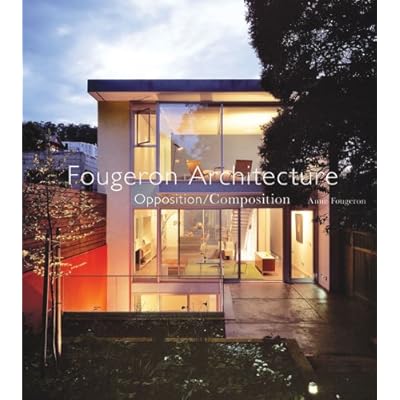
Fougeron Architecture in the NYTimes!

Delighted to let you blogfollowers know that a project I did in Potrero Hill (San Francisco) is featured in today’s New York Times!

Real archiblogging to resume on Monday! 

A Classic

What Mr. Gehry is saying, then, is that there can be beauty in such harsh elements when they are carefully wrought and precisely put together, that they can create a new kind of order which can yield as much physical ease and comfort as a conventional house. – Paul Goldberger

I just got back from LA where I went to the Gehry House for the first time in almost fifteen years. If you don’t know, the existing house was bought in Los Angeles the 1970s and then remodeled by Gehry. It is iconic modernism and deconstructivism. It has won the 25-year AIA 2012 Building award.

Frank Gehry’s architecture comes with a slew of descriptors: innovative, sensuous, modern. But the Gehry House in Los Angeles is a classic. And I know it’s hard to believe that one could ever call a Frank Gehry house a classic. But there is something so bold and yet so right about this remodel. Nothing fussy, nothing dated, even 25 years later.

I like it even better now than I did when I was a young architect because now I can actually understand just what real courage and vision it took to complete a project like this.

When Gehry purchased the property, the original house was not torn down. Instead, he skillfully wove his architecture around and against the original building. The old and new are now in a dialogue with each other, loudly but also joyfully and whimsically. Gehry had the brains, balls and restraint (an undervalued trait in architecture) to make something this good.

What a relief to see no fake historicism! No egomaniac modernism! And not even a hint of Dwell modernism (you know the kind: flat roof with extended overhangs and lots of Ipe siding! Gehry looked to innovate, to create, and not to replicate.

And despite what you may think, money was an object for Gehry. The chain-link fence or corrugated metal were inelegant, inexpensive materials for an elegant design. Cheap doesn’t always mean bad and besides, Frank Gehry still lives in the house. The project has clearly served his family well.

I will not bore you with anymore “archibabble,” considering the fact that many architectural critics have written much more insightful articles than I could about this project.

I just want you all to remember the next time you go to LA go check it out;  it will knock your socks—or flip flops (it is LA after all)–off.

For more information and quotes, keep reading after the jump.

Read more

Guest post: The Children of Architecture

This guest post was written by my daughter, who really needed a good use of all her post-college free time.

I used the title to make this blog post seem deceivingly deep, as if I’m ruminating on the status of architecture in the twenty-first century or if the progeny masters programs produce are really up to snuff.

No, no. I’m talking about the children of architects. Really, I’m talking about myself and the ways which my mother’s career choice has made my life unpleasant.

1. Dinner conversations are boring

Look, yes, architects have friends who aren’t also architects. My mother’s social circles include interior designers, landscapers, furniture designers, contractors, engineers and artists! But architects like to hang out with each other and when you get architects together, all they can ever do is talk about architecture. Sometimes, I just want to interrupt conversations with  “WHAT ARE YOUR THOUGHTS ON ISRAEL”  so I can stop hearing the word “urbanization.”

Read more

Failed First

I learned the hard way that buildings, especially the ones you don’t like, don’t go away.

The good news is, you can bury the incriminating evidence. Before starting my firm in 1986, I worked for and with other architects. And while my name and signature are somewhere on those drawings, drafts and contracts, I’ve been assured that they are deeply hidden in a storage area of pre-electronic files.

One of my very first moonlight projects was with my good friend Kent Macdonald and it was as a remodel. The project included a revamped façade.  I’d like to think that the project’s final appearance was a result of naiveté (I was paralyzed by excitement and fear) and some stubborn clients.

It has an unfortunate composition that includes two different materials that step, something we would never do today. A clumsy balcony hovers overhead. It has been repainted in the ugliest cold color that emphasize the clumsy composition.

Luckily, for a period of time, the evidence was located on a sleepy San Francisco street. Unfortunately, a popular store opened half a block away and now my abomination is passed by thousands. Worse yet, by the time I opened my own firm five years later, I was living within walking distance to the project.

Read more

Part 2 of Procrastination in the City: Les Halles

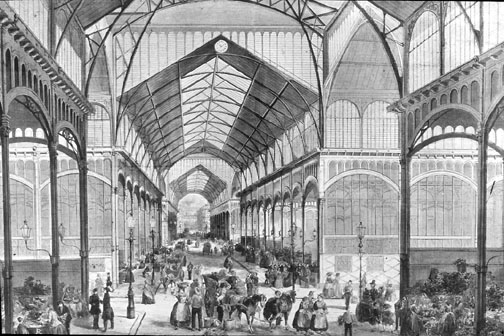
The Quartier des Halles, an area near the Louvre, is being completely torn down and rebuilt for the second time in 30 years. For many centuries it housed merchant markets but in the modern era visitors were only attracted by the nearby great museums of the city. Les Halles itself was not very useful or inspiring.

But Paris knew that Les Halles needed not only an “upgrade” but a complete reenvisioning. But it didn’t start off so well, the first plan, completed in 1979 would make most architects cringe. The buildings closed themselves off from the street and existing urban fabric of the neighborhood and the construction was terrible. The buildings quickly fell into disrepair and tourism in that area certainly didn’t blossom.

Read more

Procrastination in the City (part 1)

(Upon completing this entry, my daughter informed me that 900 words was far too long for one blog post. She then informed me she was “unaware that my mother was a woman of so many words.”)

If there’s one thing I love best about the Internet – it’s that there is no off switch. During bouts of insomnia, caused by stress or jetlag or that second Martini during dinner, I can access the whole world. There’s a different aesthetic to the kind of learning I do at 3am. More recently, I’ve become entrenched in the world of digressionary architecture research. I find myself reading blogs on Victorian architecture or tracking new projects in Australia.

Read more

Brooklyn Museum Panel

If you enjoyed my interview with the Architect’s Take on women in architecture, I’d like to invite you to the Brooklyn Museum this Friday. I’ll be on a panel discussing the role of women in the male-dominated field of architecture. 

For more information, check out the NYMag event listing.

The Architect’s Newspaper

I am incredibly honored to be featured as a studio visit on the Architect’s Newspaper!

Here’s the beginning of the article:

ImageSan Francisco’s Anne Fougeron is one of the torchbearers for women in architecture. As one of the very few to head up a design practice in the city—or in the country, for that matter—she’s learned how to make it through struggle.

“This profession is so unfriendly to women,” she said. “It’s hard for us to get work, it’s hard for us to be taken seriously. But it’s not a nice field for the guys either—so you have to buck up and just do it.” Committed to modernism and its rigors, she’s known for her elegantly detailed residences, and has made the jump to larger projects, including a branch library for the city and multifamily housing (a breadth of work explored in her recent monograph from Princeton Architectural Press).

Women in Architecture (“Because I am a woman, I must make unusual efforts to succeed. If I fail, no one will say, “She doesn’t have what it takes.” They will say, “Women don’t have what it takes.” – Clare Boothe Luce)

About a month ago, I sat down with Rebecca of the Architects’ Take to discuss what it is like being a woman in a male-dominated profession. I’ve pasted one of my favorite parts below and you can find the full interview is here.

For example, in the Architect’s Journal study about women in architecture, there was a woman who commented that Zaha Hadid’s success has resulted in her having no family life. My first reaction was “Who cares? And how is that relevant to her body of work as an architect?” Why is a family life something a successful woman has to give up? It might have never been on Zaha’s radar. How presumptuous it is for anyone to assume that Zaha is not perfectly happy with the choices she has made, both professionally and personally. Besides, just because you aren’t married doesn’t mean you are relegated to a life of spinsterhood. I remember the late 80s when that study came out saying that women over 35 were more likely to be abducted by terrorists than to get married.

Zaha could have had 7 lovers, one for every day of the week for all we know!

We – and women particularly – should all be proud of Zaha. She is a resounding success and an extraordinary architect. And frankly, I don’t hear the same criticism being applied to Rem Koolhaas. A few years ago, I remember a piece on him in the New York Times. And they were just flippantly describing his two families – one with his wife and the other with his mistress. I mean, he clearly had enough time on his hands. He had it all, and then some.

Women have a harder time than men in architecture, plain and simple. And it gets discouraging. You can get beaten down. It can be easier to find something else to do instead. I was a single mom at the same time that I had a firm, and it wasn’t easy. I didn’t have a life partner to support me; I had to work. I had some more flexibility, because it was my own firm, so I could incorporate my daughter into my work schedule. She would come to the office after school and it was fine. Or I didn’t have to ask permission to go to parent-teacher conferences. But I was the boss, and even when I could leave for an hour on a Wednesday to see her play basketball, I still had to land new jobs, make payroll, attend meetings, serve on architectural juries, and pay the rent.